
Qualified Health Information Organizations
& the QHIO Program
Facilitating the secure exchange of health and social services information on behalf of DxF participants across the state of California.
Official website of the State of California
Facilitating the secure exchange of health and social services information on behalf of DxF participants across the state of California.

Resources and information on QHIOs are available here.
Qualified Health Information Organizations (QHIOs) serve as state‑designated intermediaries supporting secure data exchange between health care providers, plans, government agencies, behavioral health, and social service organizations. By offering trusted connectivity services, QHIOs help required participants meet their obligations under the Data Sharing Agreement (DSA) and its associated Policies and Procedures (P&Ps). These connections strengthen interoperability statewide, enabling real‑time, secure information exchange and improving care coordination and patient outcomes.
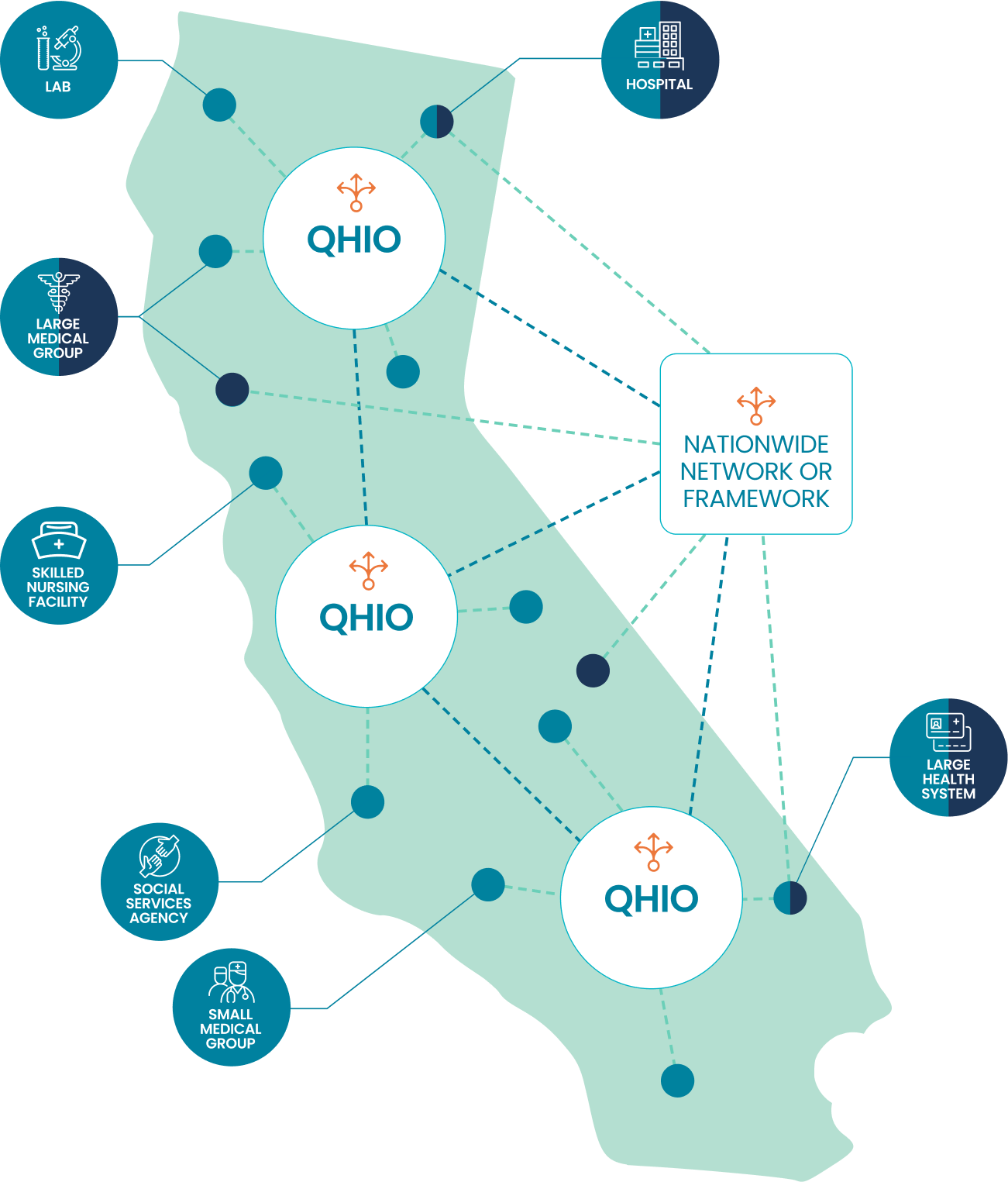
QHIOs are state-qualified organizations uniquely suited to:
DxF Participants may choose to securely exchange data through a QHIO to comply with the DxF’s DSA and its P&Ps.

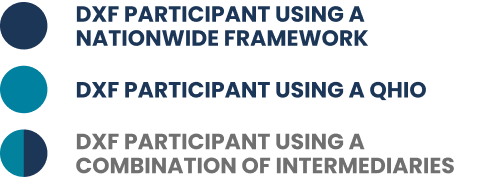
A DxF designated intermediary that can help Participants to facilitate the secure exchange of health and social services information between Participants.

Any vendor-agnostic health information network or health information exchange framework with nationwide scope, including coverage in California, available to some or all Participants for the exchange of health and social services information that may or may not have signed the DSA.

An organization that is a signatory to the DSA, including any identified subordinate entities of that Signatory.

the rules of the road adopted by the California Health and Human Services Agency pursuant to the DSA of that signatory.
California currently has 8 designated QHIOs. Find the one that is right for you:
For more information about each QHIO, take a look at the About the QHIOs guide.
Patient Information, Securely Available.
A goal of the DxF is that every Californian be able to walk into a doctor’s office, a county social service agency, or an emergency room with the confidence that their care team can access the information necessary to deliver safe, effective, whole-person care. At the same time, individuals must be assured that their personal data is protected through robust privacy and security safeguards.
The DxF limits the use and disclosure of individual data to what is legally allowed and operationally necessary to provide care and services to the individual patient, and it adopts the Health Insurance Portability and Accountability Act (HIPAA) Security Rule as the floor for security protections. The DxF does not allow any organization to bypass applicable privacy law, including California law. Further, QHIO’s are required to maintain the highest level of HITRUST r2 security certification to remain qualified by the program.
No FAQs match your search.

The full Data Exchange Framework FAQ is available here.
Find additional information about the Data Exchange Framework and ongoing implementation by visiting the DxF Participant Center.

Governance information is available here.
The establishment and implementation of the DxF is made possible through a comprehensive, open, and public process to ensure transparency and accountability.
